

How to Travel to Tenerife
FLIGHTS, AIRPORTS, TRANSFERS AND EVERYTHING YOU NEED TO KNOW
Your journey, made effortless
From choosing the right airport to exploring the island by car, here is how to
make your journey to Tenerife as effortless as the stay itself.
Tenerife may feel wonderfully removed from everyday life, but reaching it is surprisingly
straightforward. The island is connected directly with cities across the United Kingdom, Ireland and
continental Europe, while frequent flights from mainland Spain make Tenerife accessible from almost
anywhere in the world with a single connection.
The more useful question is not simply how do you get to Tenerife? It is which airport to choose, where
to stay once you arrive, and how best to explore an island whose landscapes change dramatically within
a relatively short distance.
This guide brings those decisions together. It explains Tenerife’s two airports, direct-flight options,
transfers to Costa Adeje, local taxi apps, car hire and whether it is worth dividing your holiday between
the north and south.
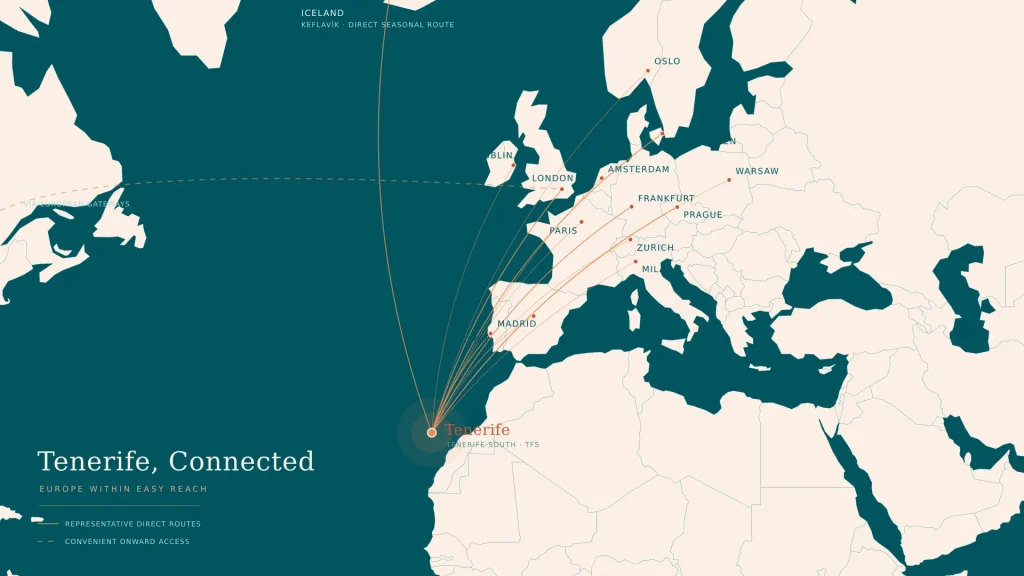
Tenerife is connected directly with destinations across Europe; routes and frequencies vary by season.
Which airport should you fly into for Tenerife?
Tenerife has two airports: Tenerife South Airport (TFS) and Tenerife North-Ciudad de La Laguna Airport
(TFN). Both serve the same island, but they are useful for different kinds of journey.
Tenerife South Airport (TFS)
Tenerife South is the principal arrival point for most international visitors. It receives direct services
from across Europe and is the natural choice for stays in Costa Adeje, La Caleta, Playa de las Américas,
Los Cristianos, El Médano and the rest of southern Tenerife.
For guests staying with us in upper Costa Adeje, the drive from Tenerife South Airport is normally
around 20 minutes, depending on traffic and the exact route. This makes arrival pleasantly
For guests staying with us in upper Costa Adeje, the drive from Tenerife South Airport is normally
around 20 minutes, depending on traffic and the exact route. This makes arrival pleasantly uncomplicated: collect a hire car or meet your transfer, join the TF-1 motorway and, before long, the
holiday has begun.
Tenerife North-Ciudad de La Laguna Airport (TFN)
Tenerife North is particularly convenient for Santa Cruz, La Laguna, Puerto de la Cruz and northern
Tenerife. It is an important hub for flights between the Canary Islands and also serves a broad selection
of routes to mainland Spain.
You can certainly reach Costa Adeje from Tenerife North, but the journey is much longer than from
Tenerife South. Unless the route or fare offers a compelling advantage-or you are beginning your
holiday in the north-Tenerife South will normally be the better choice for a stay in Costa Adeje.
Direct flights to Tenerife
Tenerife South has one of the most extensive international route networks in the Canary Islands. At the
time of this update, airport operator Aena lists 94 destinations served by 41 airlines, although individual
routes and frequencies can change with the season.
From the United Kingdom, Ireland and continental Europe
Tenerife South has extensive direct connections with the United Kingdom and Ireland, Scandinavia,
Germany, France, the Netherlands, Belgium, Switzerland, Italy, Portugal and Central and Eastern
Europe. For many travellers, reaching the island requires no connection at all.
There is little value, however, in reproducing an airport timetable here. Routes and frequencies change
by season, and an airline serving Tenerife in winter may operate less frequently-or not at all-during
another part of the year. The useful starting point is Aena’s live Tenerife South destinations directory,
where travellers can search current destinations and see which airlines serve each route. Once you
identify the practical options, compare dates, baggage conditions and fares directly with the airlines.
Travellers from Scandinavia should pay particular attention to seasonal nonstop services and compare
them with one-stop itineraries through Madrid, Barcelona, Amsterdam or another European gateway.
From mainland Spain and the Canary Islands
Madrid and Barcelona provide convenient connections for travellers arriving from destinations without a
direct Tenerife service. Additional links connect Tenerife with cities across mainland Spain, while
frequent inter-island flights make it easy to combine Tenerife with Gran Canaria, Lanzarote, La Palma or
another Canary Island.
From North America and other long-haul destinations
Tenerife has had a direct connection with North America. United Airlines operated a seasonal nonstop
service between Newark Liberty International Airport (EWR) and Tenerife South (TFS), giving travellers
from the New York and New Jersey region a remarkably simple journey to the island. The most recently
published service ended in March 2026 and, at the time of this update, no new nonstop dates are shown
in the current schedules.
The route is worth checking when planning a future trip because seasonal air services can return.
Search United’s current flights to Tenerife and Aena’s live destination list before assuming that a
connection is necessary.
For most North American travellers at present, the simplest itinerary is one connection through Madrid,
Lisbon, London or another well-connected European gateway.
When comparing flights, search both TFS and TFN, but remember that a slightly lower fare into Tenerife
North may be offset by the longer transfer to southern Tenerife.
Arriving in Costa Adeje
There are four practical ways to travel from Tenerife South Airport to Costa Adeje: a hire car,
prearranged private transfer, airport taxi or public bus.
Private airport transfer
A private transfer is the most effortless arrival option, particularly after an evening flight or when
travelling with children and several pieces of luggage. Your driver meets the flight, knows the
destination in advance and takes you directly to the property.
For groups, the difference in cost compared with several separate tickets or taxis may be smaller than
expected. It also removes the need to navigate immediately after landing.
Airport taxi
Official taxis are available outside the terminal. They are convenient for direct travel, although the final
fare varies with the destination, time and applicable supplements. Keeping the property address and
map pin readily available will make the journey easier.
Public bus
Tenerife’s public bus network is operated by TITSA-the island’s buses are known locally as guaguas.
Routes serving Tenerife South Airport currently include the 10, 40, 711, 343 and 415, with Route 40
providing a useful connection towards Costa Adeje and Los Cristianos. Services and timetables change,
so consult TITSA’s Tenerife South Airport information before travelling. The bus is economical, but it will not take you directly to a private home. Guests staying in upper Costa Adeje will generally need a taxi for the final part of the journey, particularly with luggage.
Getting around Tenerife: taxis, TaxiClick and Uber
For local journeys-dinner in La Caleta, a day beside the sea or an evening when nobody wants to
drive-taxis are a practical choice.
The TaxiClick app is especially useful for international visitors because it connects passengers with the
established local taxi network without requiring a telephone call. The app uses your phone’s GPS to
communicate the precise pickup position, and you can enter the destination before the taxi arrives. This
avoids uncertainty over pronunciation, unfamiliar street names or explaining the location of a private
villa.
Uber is also available in Adeje. It offers the familiar app-based experience of entering the pickup point
and destination in advance. Availability can be more limited than in a major city, however, so allow
additional time or reserve ahead when the journey is important.
For either service, location accuracy matters. At a beach, trail, restaurant or large residential complex,
check that the map pin is positioned where a vehicle can safely stop-not merely where you happen to
be standing.
Do you need to hire a car in Tenerife?
A car is not essential if the intention is to relax at the property and spend most days around Costa
Adeje. Taxis, TaxiClick, Uber, private transfers and buses can cover many everyday journeys.
However, we strongly recommend hiring a car if you want to discover Tenerife beyond the resort
centres. A car gives you the freedom to combine places that are difficult to connect efficiently by public
transport, stop when a view catches your attention and allow the day to unfold without being governed
by a timetable.
One easy excursion from Costa Adeje pairs a beach morning at La Tejita, beneath the distinctive
Montaña Roja, with a relaxed lunch in Los Abrigos, a fishing village known for fresh fish and waterfront
restaurants. The two belong naturally to the same day by car.
On another morning, leave early for Teide or follow a self-guided journey north through changing
landscapes, historic towns and volcanic coastline. The road itself becomes part of the experience:
Canarian villages, unexpected viewpoints and places an organised excursion may pass without
stopping.
A hire car allows you to:
- Discover fishing villages and restaurants beyond the principal resort areas.
- Combine a beach, a scenic drive and lunch in one unhurried day.
- Explore Teide, Anaga and northern Tenerife at your own pace.
- Stop at viewpoints and small places that rarely appear on conventional tours.
- Follow the Stay With Us interactive map and self-guided itineraries.
- Return when you choose rather than planning around the final bus or an arranged pickup.
If you expect to explore frequently, collecting the car at the airport is usually the simplest option. It
combines the transfer and car hire in one step. If the first part of the holiday is devoted to the pool,
terrace and nearby restaurants, hiring a vehicle only for selected days may make more sense.
Choose the vehicle with the island in mind. A very large car can be less comfortable on village streets
and in older car parks, while the cheapest engine may feel underpowered on Tenerife’s steeper roads. A
compact or medium-sized car with enough power for mountain routes is often the most practical
balance. Always review the insurance terms, fuel policy, security deposit and after-hours return
procedure before booking.
Why stay in upper Costa Adeje?
Costa Adeje is often described as though it were a single resort, but there is another side to it above the
coastal centres.
Staying on the upper side of the TF-1 offers quiet residential surroundings, open views and welcome
distance from the traffic and late-night activity of the busier resort areas. You remain close to the
beaches, restaurants, golf courses and attractions of southern Tenerife, but you return at the end of the
day to somewhere calmer and more private.
The location is also particularly effective as a base for exploring. Rapid access to the TF-1 means you
can set out north or south without first negotiating the congestion of the coastal centres. La Caleta, Los
Cristianos and the southern beaches remain within easy reach, while the motorway places the airport
and the rest of the island on a straightforward route.
It is, in many ways, the best of both versions of Costa Adeje: close to everything, while removed from
the noise of everything.
This is part of the appeal of both Stay With Us Collection properties. Roque-House offers an intimate,
elevated home for couples, families or smaller parties, while Red-House provides the space and privacy
of a substantial villa. Each allows guests to enjoy Costa Adeje without needing to live in the middle of its
busiest streets.
Should you divide your Tenerife holiday between the north and south?
North and south Tenerife can feel like two different islands. The south is known for dependable
sunshine, dramatic arid landscapes, beaches and outdoor living. The north is greener, more traditional
and closely connected to historic towns, gardens and Tenerife’s agricultural heritage.
For a longer holiday, dividing the stay can be rewarding. Travellers with ten days or more may enjoy
spending several nights in the north before settling into the warmth and ease of the south-or the other
way around. A split stay allows time to experience each region slowly, especially if discovering local
towns and landscapes is a central purpose of the journey.
For a shorter visit, changing accommodation may consume more time than it saves. Tenerife is compact
enough for much of the north to be explored on a thoughtfully planned day journey from Costa Adeje. A
car and an early start make it possible to experience the island’s changing character without repacking
halfway through the holiday.
Our general recommendation is simple:
- Our general recommendation is simple:
- Five to seven nights: choose one base and explore from there.
- Ten nights or more: consider a split stay if slow discovery of the north is a priority.
- For sunshine, private outdoor living and convenient access across the island: make Costa Adeje your principal base.
Can you travel to Tenerife by ferry?
Yes. Ferries connect Tenerife with other Canary Islands, making sea travel useful for an island-hopping
itinerary or for bringing a vehicle from a neighbouring island. There are also services from mainland
Spain, although the journey is far longer than flying and is generally chosen by travellers who value the
voyage itself or need to transport a car.
Tenerife’s principal ferry ports are Santa Cruz in the north-east and Los Cristianos in the south. Check
the operator’s current port, sailing time, vehicle conditions and check-in requirements carefully, as
these vary by route.
A few practical decisions before you book
Before confirming the journey, consider the entire arrival rather than the airfare alone:
- Search both Tenerife airports, then account for the onward transfer.
- Check whether the flight is seasonal and verify the schedule directly with the airline.
- Choose airport car hire or a private transfer in advance if arriving late.
- Save the property address and precise map pin offline before travelling.
- Review the current travel-document requirements for your nationality through the official Spanish authorities or your government’s travel service.
- Plan the first evening gently. A smooth arrival, something waiting in the fridge and time to settle in are
- worth more than an ambitious itinerary on day one.